
Tope Handling and Measuring
Weight Formula
Measure the top from tip of nose to tip of tail in inches.
Weight
Girth x Girth x Length / 800 = weight in pounds
Equipment:
- Wire cutters – to cut the wire or monofilament trace if you cannot get the hook out with ease
- ‘T Bar’ – in case you need to release the shark at the side of the boat. You should have these even if you plan to land the
- Unhooking mat, as used by carp anglers – to place the fish on instead of a wooden deck or hot engine cover
- Pliers – to remove the hook
- Tape measure – to ‘weigh’ the fish (read article for more information)
Be certain to have all the equipment to hand, including a camera. This greatly reduces the time that the fish is out of the water.
Tope are a very mean looking fish, with their sharp teeth and their muscle packed bodies, so you would probably be forgiven to naively believe they are not a particularly delicate fish. This could not be further from the truth. Really this shark is a very delicate creature, which must be treated and handled with the utmost care and respect.
We must remember that a shark is a fish, a creature that has adapted and evolved to life under water and not above it. Until you explore the build of a shark, it is hard to gain a mental image of their skeletal structures. Unlike humans, a shark does not have a rib cage to protect its vital internal organs so great care must be taken when landing, unhooking, holding and releasing the creature.
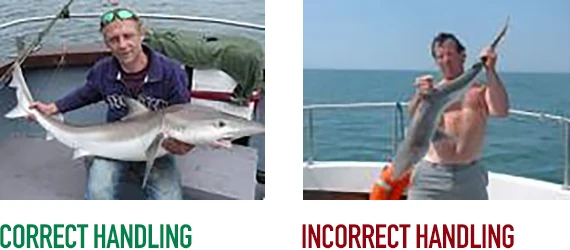
There is a common misconception that a shark should be held by the tail and its pectoral (side) fin or dorsal (back) fin, which certainly is not the best method. As explained before, the shark is vulnerable out of the water because they do not have a ribcage, although they do not need it under the water. When out of water, gravity is acting on the shark’s organs, which can cause harm and distress to the fish. Without doubt, the best possible way to handle a shark is by holding its tail and supporting as much of its belly as possible, which helps to counteract the effects of gravity.
Landing a shark is also a time where great care needs to be taken. Dragging the fish over the side of the boat or over the rails can have devastating effects on the shark’s internal organs. Although you may not be able to tell the fish has sustained any injury, it could have long lasting effects on the fish and may even lead to it’s death after release.
To land a shark, you must first be certain that the fish is tired out and that it is unlikely to thrash around. Things soon become extremely dangerous if a shark that has not been worn out is brought onboard. The shark may thrash around resulting in damage to the shark and people onboard the boat could also sustain injury from the shark’s sharp teeth. Although it may seem obvious not to bring a shark onboard when it is not tired out, I have seen footage of a fisherman boating a tope and standing on it to stop it from thrashing. This is completely unacceptable by any standards!
Once the shark is tired, bring it to the side of the boat and take the leader in one hand so that you have control over the fish. Get the fish parallel to the boat so that you can get both hands to it, but do not grab at it. The most effective way of picking a shark out of the water that I have found is: With your free hand, whilst still holding the leader in the other, take hold of the shark’s tail and be sure that you have a firm hold of it.
Lift the tail slightly out of the water so that you have complete control of the shark.
When you are certain the fish is not going to thrash, release the leader and place your hand underneath the shark’s belly. Take care as the shark’s mouth and teeth are on the underside of the shark. These teeth are
extremely shark.
In one smooth motion, lift the fish with both hands, supporting the belly of the shark, over the side of the boat and place it down on an unhooking mat.
A good tip is to place a wet towel over the shark’s head as soon as you have placed it on the unhooking mat. This helps to calm the fish and reduces the chances of the fish thrashing around.
When you bring a tope to the side of the boat and its stomach has been ejected through its mouth, do not be alarmed. This is a self-defence feature of the tope so once released, it will just swallow the stomach again and the fish will be fine. Should you catch a tope that has ejected its stomach, do not land it. Simply release it using a ‘T Bar’ so that it has the opportunity to swallow its stomach again. This is why I earlier stated that you should always have a ‘T Bar’ at hand.
Unhook the fish on the unhooking mat using strong pliers. Do not simply rip the barb of the hook back out of the fish but instead, carefully slip the barb back through the hole that is already present from when the barb went in. This again reduces the amount of stress on the fish.
If you plan to weigh your tope, be sure to buy a good weight sling. Buy a weigh sling that has carbon rod supports along the top, as this will support the shark’s organs. Do not use a weigh sack, as this will not provide the necessary support that the fish needs on its belly.
A method to eliminate the need for weighing scales and slings is ‘weighing’ the fish using a tape measure. This may sound absurd, although, it is a very accurate method for finding the tope’s weight. We do this using a formula:
- Measure the tope’s girth at the widest point in inches.
- Measure the length of the tope, again in inches, from the tip of its nose to the tip of its tail.
- Put the measurements into the following formula:
Girth x Girth x Length / (divided by) 800 = weight in pounds
This completely eliminates the need for weighing a tope using a sling and scales, which saves you time and money and saves stress to the tope.
When returning the shark, I like to lift the fish on the unhooking mat, which supports all of the shark’s body. It is important to ensure that the shark does not slide off the mat. Simply place the shark, on the mat, into the water and allow it to go into the water. Be sure to keep hold of the mat. Whilst holding the mat in one hand, take the shark’s tail with your free hand to support the fish and then slip the mat from under the fish. Now place your other hand back onto the fish, again to support it. Once the shark has its power back, it will start to try to swim away. Keeping one hand on the tail let go of the fish with the other and as the fish starts to kick, release the tail. The shark will simply glide away.
You cannot go too wrong if you follow these instructions and always support the fish. Give the shark the respect it deserves and you will have a pleasant day’s fishing without causing any harm to the fish.